
Industrial Hose
Assembly Instructions
Guidance for Industrial Hose Assembly Instructions
In the industrial hose sector, regulation of the hose assembly process is, in most cases, linked to the assembler’s experience.
Norms that precisely describe the assembling process do not exist.
Basic generic guidelines on hose assembling process are available from hose manufacturers and distributors, but in the field each assembler manufactures hose assemblies according to his knowledge which is usually based on experience.
The main two types of hose assembling are crimping and clamping.
Manuli Hydraulics recommends selecting the crimping of industrial hoses for the following reasons:
- Crimped solutions offer a superior seal compared to clamps, making the hose assembly more reliable against leaks, especially in high pressure applications;
- Crimped solutions favour safety more than clamps.
1. Clamping
The clamping system available in the industrial hose sector can be proposed by assemblers for low pressures and for applications that don’t have a severe mission profile (eg: general purpose applications, water low pressure, etc.).
Commercial clamps are widely available on the market to suit specific applications.
The SERRATED insert by Manuli can be used for assembling with market clamps, provided that assemblers carry out dedicated laboratory verifications, proof test and field tests, to ascertain the performance requirements of the assemblies.
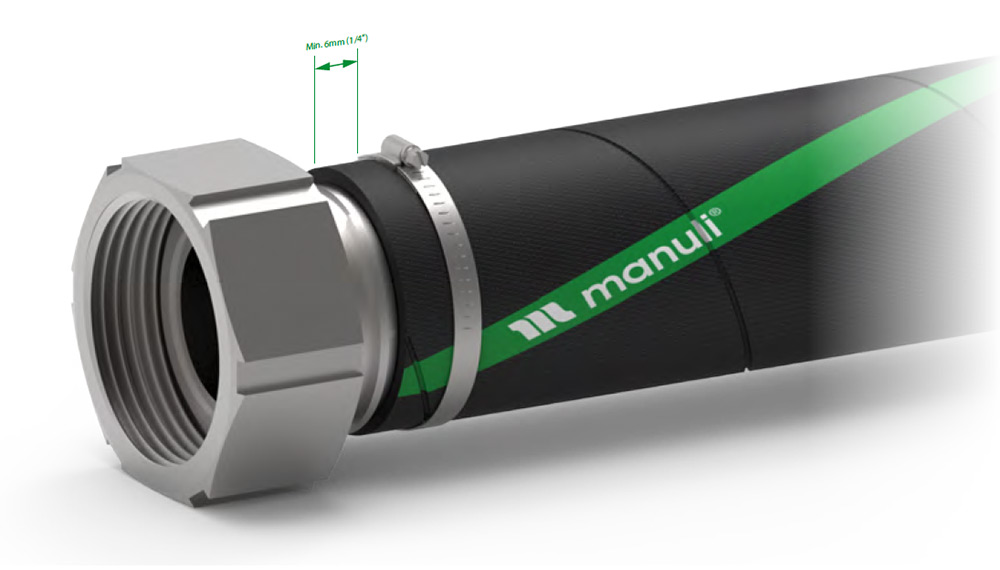
Clamping Process
The clamp installation process is as follows:
- Measure the outside diameter of the hose and select the clamp by checking its range.
- Slide the hose clamp over the hose and insert the fitting into the hose.
- Position the clamp over the joint between the fitting and the hose.
To reduce the risk of leaking the clamp needs to be placed at least 6mm (1/4”) from the end of the hose);
- Tighten the bolts up to reach a sufficient compression of the hose wall to keep firmly fixed the hose onto the fitting.
- Consult the clamp manufacturer for proper torque moments of bolts or screws.
2. Full-Flow Fitting Assembly
Manuli Hydraulics offers full-flow fittings for use in high-pressure concrete conveyance (ABRASERVICE/100 D), and designed to provide minimal resistance to flow by providing a “smooth bore” interface between the fitting and the hose.
Due to the high insertion force required for deformation of the hose end, an Insert Pushing Machine is required for this operation.
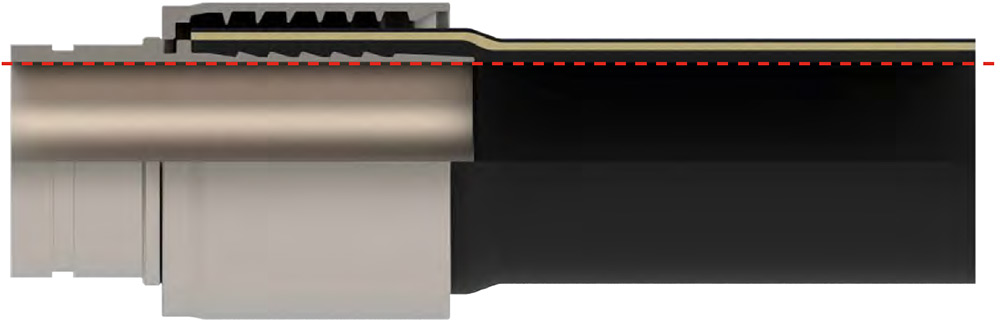
2.1 – Insert Mounting
- Locate the ferrule on the hose.
- Clamp the hose securely in the insert pushing machine.
- Lubricate the outer surface of the insert with a light oil.
- Locate the insert in the insert pushing machine and ensure that the insert and hose are axially aligned.
- Push the insert into the hose until it reaches the mechanical stop on the insert
Note: The hose should visibly deform around the insert.
2.2 – Crimping & Validation Procedure
- Carry out the crimping and validation of the hose in accordance with the instructions provided in the previous section of this document.