
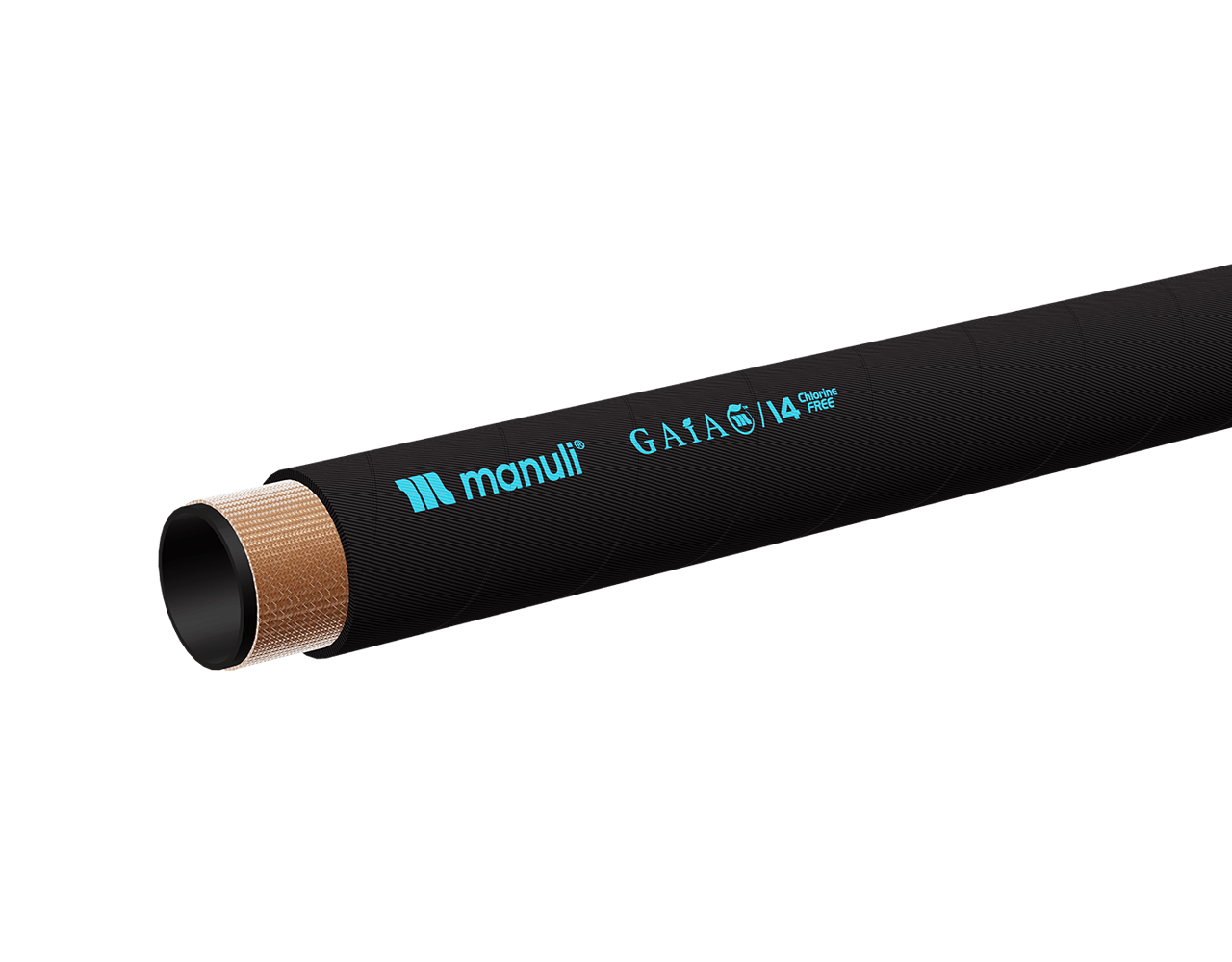
GAIA/14
CHLORINE-FREE LINE
KEY FEATURES
• Compact dimension
• Very low bend radius, suitable for difficult installations
• High flexibility
• Outstanding abrasion and ozone resistance
• Flame retardant MSHA approved cover
• MiniFit special dedicated fittings, compact dimensions
APPLICATIONS & FLUIDS
- Hydraulics: low pressure lines, auxiliary hydraulic systems for OEMs and high performance applications
- Mineral oils, vegetable and rape seed oils, glycol and polyglycol based oils, synthetic ester based oils, oils in aqueous emulsion, water
CONTINUOUS SERVICE TEMPERATURE RANGE
-46 °C, -50 °F
121 °C, 250 °F
TUBE
Oil resistant synthetic rubber
REINFORCEMENT
One high tensile steel braid (DN 31 with two wire braids)
COVER
Chlorine-Free STRONG cover style, synthetic rubber with extreme abrasion and ozone resistance
APPLICABLE SPECS
ISO 18752 Grade C
TYPE APPOVALS
MSHA
| TECHNICAL DATA | |||||||||||||||||
|---|---|---|---|---|---|---|---|---|---|---|---|---|---|---|---|---|---|
 |
 |
 |
 |
 |
 |
 |
 |
 |
|||||||||
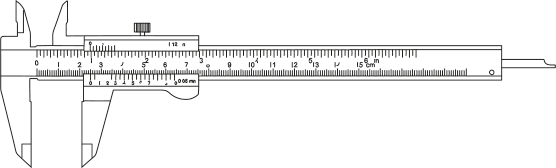
| PART REF. | HOSE SIZE | R.O.D | O.D | MAX. W.P | BURST | MIN. BEND | WEIGHT | FITTINGS | |||||||||
| DN | dash | inch | mm | inch | mm | inch | bar | psi | bar | psi | mm | inch | g/m | lb/ft | Std 1 | Std 2 | |
| H01206006* | 6 | -4 | 1/4″ | 9.9 | 0.38 | 11.5 | 0.45 | 140 | 2,030 | 560 | 8,122 | 25.0 | 0.98 | 160 | 0.11 | MF + M03300-04 | |
| H01206016* | 16 | -10 | 5/8″ | 20.6 | 0.81 | 22.4 | 0.88 | 140 | 2,030 | 560 | 8,122 | 90.0 | 3.54 | 446 | 0.3 | MF + M03400-10 | |
| H01206019* | 19 | -12 | 3/4″ | 23.9 | 0.94 | 25.9 | 1.01 | 140 | 2,030 | 560 | 8,122 | 100.0 | 3.93 | 571 | 0.38 | MF + M03400-12 | |
| H01206031* | 31 | -20 | 1.1/4″ | 41.1 | 1.61 | 43.6 | 1.71 | 140 | 2,030 | 560 | 8,122 | 250.0 | 9.84 | 1,558 | 1.05 | MF + M03400-20 | |
DISCLAIMER:
We reserve the right to modify our products and/or related services and/or discontinue the manufacture and/or supply of any of the products and/or related services, without notice. This document supersedes all previous versions and previously issued documentation. The only official source of technical crimping parameters regarding our products is our Digital Crimp Tools. Printed copies are uncontrolled therefore, please be sure to use the latest versions of our Manuli Crimp App or Manuli Crimp Web Tool. Don’t mix and match: always use original hoses and fittings. For more information, see our ‘Safety Guide’.